WA Ballet Visit – Perth Children’s Hospital
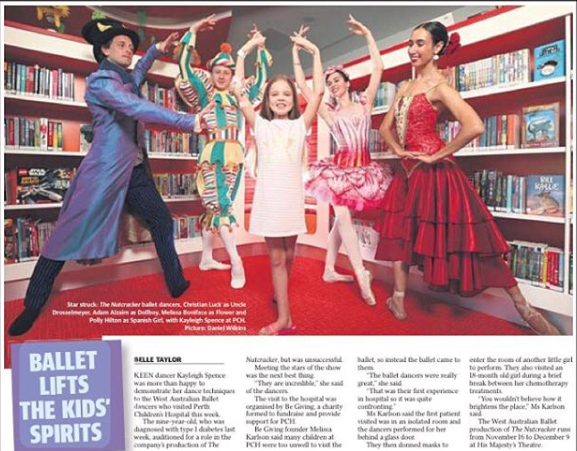
Something that I have recently been involved with was helping to coordinate a visit by the WA ballet cast of the nutcracker to the Perth Children’s Hospital through my internship.
I have inserted a media article below that followed the visit and was published in The Sunday Times.
The Fault In Our Stars – Perth Private Screening
Drawing on some of my previous experiences, this is a video that somewhat showcases an event I was a huge part of organising before I started University. Myself and a few others organised a fundraising screening of ‘The Fault In Our Stars’, and this really sparked my interest in event management, Public Relations and the concept of being a part of something big. We had singer Troye Sivan and his YouTuber brother Tyde Levi attend, and we planned a series of fundraising opportunities throughout the day. This is one of the experience that I would say has shaped my choice in degree and career path. Although the video is old, and the quality was not good, I think it gives an idea of where I began.
Social Media Profile
Below is a Social Media Profile I had to put together for my Social and Online Media Strategies class. This assignment was really helpful for me in learning how to analyse social media activity and behaviour, and how to get the most out of social media.
Social Media Profile – Malcolm Turnbull
Political figures are their own brand. The way that they as a public figure are branded on social media is largely important to public perception and is often plays a huge part in campaigns and public information. The way ‘Social fragmentation and the decline of group loyalties have given rise to an era of personalized politics in which individually expressive personal action frames displace collective action frames in many protest causes.’ (Bennett, 2012), has placed significant importance on how individual politicians market themselves and their personal brand to voters is more important than ever before. Looking specifically at Malcolm Turnbull and his social media/online presence, this report will allow an insight into how one politician is using social media in our modern society.
A Brief Overview of the Organisation’s/Brand’s key values and messages
Malcolm Turnbull is the current leader of the Australian Liberal Party, elected member for Wentworth and current Australian Prime Minister. His website and social media pages do not generally state a mission statement or key values, but as he is representative of the liberal party, it could be assumed that he is representative of those messages and values. The liberal party website has a section titled ‘Our Beliefs’ that lists off a whole host of things they stand for, but one segment stands out; ‘In short, we simply believe in individual freedom and free enterprise’ (Liberal Party of Australia, 2017). This statement is clear on the Liberal Party website, but these messages are not consistent across Malcolm Turnbull’s own social media. He instead focuses on the current work the party is doing, or he is doing personally. The key messages he tries to show are usually focused around the positive things happening in parliament. Other messages reflected are those of local focus, or personal focus.
An overview of internet and social media presence
There are several means of online presence in which Malcolm Turnbull participates. He has his own website and blog, but is also present on Facebook, Twitter and Instagram. Focusing in on Mr. Turnbull’s Instagram presence, it’s easy to see that it is an even mix of personal focus and focus on his political career. His Instagram page has 79,000 followers, 909 posts and is verified by Instagram. His presence is important across all channels as it is largely important for politicians to acknowledge the ‘potential of social media to facilitate more participative democracy while acknowledging its disruptive value for challenging traditional interests and modes of communicative power’ (Loader and Mercea, 2011). A recurring theme seems to be a post of multiple photos giving an outline of what he did that day, showing off the positive parts of the day. There are also posts outlining largely important moves in terms of politics, such as calls and meetings with other important political figures, trips to schools, building sites, and even recognizing indigenous culture. There are also some personal, sentimental posts, such as pictures of him and his wife hiking, reading to his grandchildren and celebrating occasions such as mother’s day. Overall, the posts are fairly consistent, and give any consumers the idea of him being a family man, who is deeply invested in his political work. This consistency in messaging is incredibly important. Some of the posts are questionable, and may make someone feel like they are looking through what their grandparents Instagram feed might look like, but overall there is a level of consistency.
An Evaluation of this Presence
Malcolm Turnbull (or rather, his social media team) have employed some important characteristics to his posts that make them quite successful. One key thing that has been employed in this is the use of faces in majority of posts. As simplistic as it sounds, humans are intrigued by faces, ‘results show that photos with faces are 38% more likely to receive likes and 32% more likely to receive comments, even after controlling for social network reach and activity.’ (Bakhshi, Shamma & Gilbert, 2014). This is one key rule for any social media posting, as this attraction to faces ensures a much better return on posts, in terms of likes and comments. Although his posts are less frequent on Instagram than other social networks, the updates are still fairly consistent and frequent enough to keep followers interested. The use of personal touches shows his humanity, making posts that include family and friends, not just his political career, is important to painting him as a human being, not a political robot. These personal posts gain a fair bit of momentum, and sometimes have in excess of 4,000-5,000 likes, which on an Instagram page with 79,000 followers, is actually a fairly good return. Some of the images are clearly taken by professional photographers or a social media team and are well framed and put together while others are not so much. A photograph from an August 4th trip to Broome that was not framed well at all, had a cluttered frame and was overall not a great image, only received 752 likes, while a slightly better image of having tea with the creation president received 1,142 likes. This significant difference is all thanks to just a slightly better image. As mentioned before, some of his personal posts, such as a selfie of him and his wife hiking up a mountain (4,055 likes), are very popular. Though the comments across all of his posts of recent leave something to be desired, as they are largely comprised of disgruntled members of the LGBT community and others standing up for them LGBT community, in the lead up to Australia’s upcoming same-sex marriage postal vote. Unfortunately, likes aren’t everything. Videos generally receive between four and six thousand views, which is huge compared to the likes, which gives a general consensus that more people are seeing his posts than are engaging with them. Using these numbers to analyze some of the above posts, would mean that only a small portion of the people seeing the images actually engage with them. This gives an indication that perhaps there is something missing from the puzzle, as the engagement levels on the posts are way down. Overall, his Instagram page is not performing exceptionally well, but isn’t bad either, with a few tweaks, Mr. Turnbull’s page could be engaging a lot more people.
How each platform works alongside other interactive internet/social media platforms for brand engagement/enhancement
As mentioned previously, Malcolm Turnbull is present across most major social networks (Facebook, Twitter & Instagram) as well as having a website that is inclusive of a more personal blog. These platforms all work well alongside one another as the posts on Instagram are often followed up by a link to a blog post or article on his personal website, interconnecting the platforms. Some twitter posts link back to a Facebook post and vice versa, all link back to his website regularly. Each platform also lists the website on the bio of the page, making it easily accessible and enhancing the way he is branded. One noticeable thing across the networks is that the images used for profile pictures and headers/banners are not consistent. This is an easy fix but something that would just add another element of professionalism to the pages, and would make his personal brand more recognizable by the general public. This would make the transition between networks smoother as well, should one network link to another, having that easily recognizable brand is an advantage. Overall, I feel like the messages amongst the pages are similar, and that the key messaging and branding in this aspect remains well put together, and the way all of the networks work alongside each other is important, and fairly well managed, but could use some improvement.
Examples of issues, crises, events to be included
There are many recent issues, crises and events that need to be kept in mind when working with a [political figure like Malcolm Turnbull. Two large ones that keep reappearing in the comments sections across all platforms are the Same Sex Marriage Postal Vote and The Family Law Courts. These two issues are largely hot topics as far as social justice goes, and as the same sex marriage debate is being talked about a lot in the media, it most probably will continue to be. Though Mr. Turnbull’s response to both on social media has been minimal, he has made statements in press conferences etc. that have been posted to his social media and websites. His team does little in terms of damage control in the comments section, and allows the general public to go to town on any topics in the comments of his posts. Generally, once a post is made, there is no reaction to any other comments on the post by Mr. Turnbull or his team. This way of dealing with issues and crises means that instead of talking with individuals, one post is made and informs a large group of people at once. As a politician, there are endless amounts of unfolding possible issues, crises and events, the best that can be done is build up good will for when such crises hit.
References
Bakhshi, S., Shamma, D., & Gilbert, E. (2014). Faces engage us. Retrieved 6 September 2017, from http://dl.acm.org/citation.cfm?id=2557403
Bennett, W. (2012). The Personalization of Politics. The ANNALS Of The American Academy Of Political And Social Science, 644(1), 20-39. http://dx.doi.org/10.1177/0002716212451428
Loader, B., & Mercea, D. (2011). NETWORKING DEMOCRACY?. Information, Communication & Society, 14(6), 757-769. http://dx.doi.org/10.1080/1369118x.2011.592648
Malcolm Turnbull. (2017). Facebook.com. Retrieved 6 September 2017, from https://www.facebook.com/malcolmturnbull/
Malcolm Turnbull (@turnbullmalcolm) • Instagram photos and videos. (2017). Instagram.com. Retrieved 6 September 2017, from https://www.instagram.com/turnbullmalcolm/?hl=en
Malcolm Turnbull (@TurnbullMalcolm) on Twitter. (2017). Twitter.com. Retrieved 6 September 2017, from https://twitter.com/TurnbullMalcolm
Our Beliefs. (2017). Liberal Party of Australia. Retrieved 6 September 2017, from https://www.liberal.org.au/our-beliefs
 Kayla's Creativity Project